What the withdraw page shows
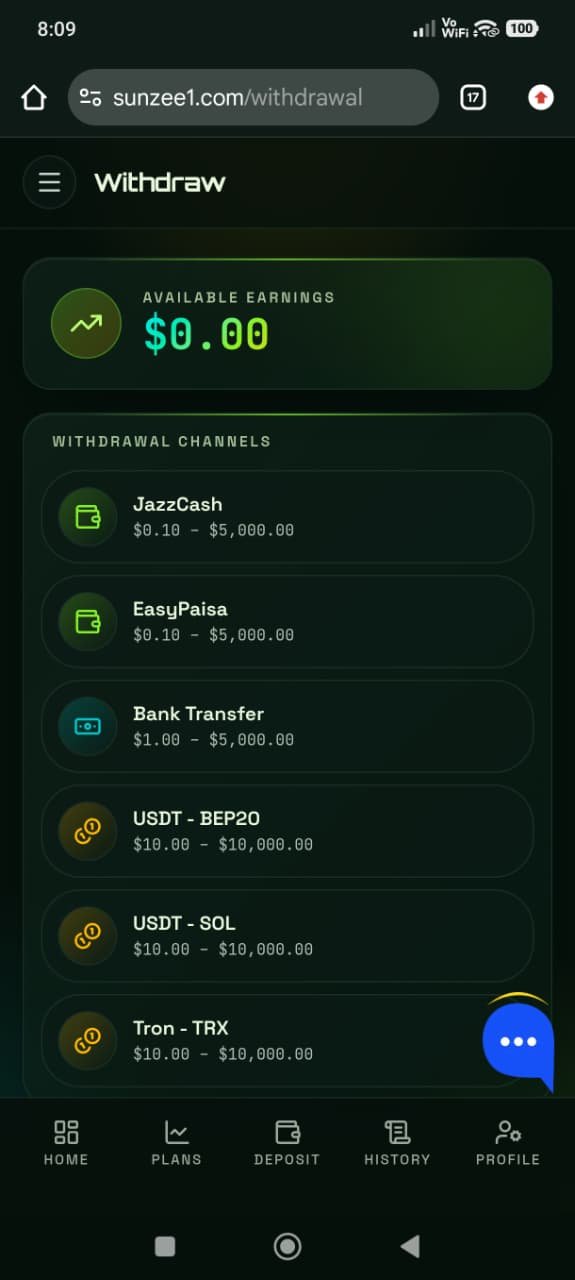
Sunzee1’s withdrawal screen displays your “available earnings” at the top and a list of channels below — JazzCash and EasyPaisa (from as little as $0.10), bank transfer, and crypto such as USDT on BEP-20, Solana and Tron. It reads like a normal cash-out page, complete with tidy minimum and maximum limits. That professionalism is the point: it makes the balance feel real and withdrawable, encouraging bigger deposits.
Stage 1 — The bait: small withdrawals that work
Early on, small withdrawals often do arrive. This is the most important trick in the whole scheme. A successful Rs 500 or Rs 1,000 cash-out converts a curious user into a confident promoter. You screenshot the payment, share it, and reinvest more. Those honoured withdrawals aren’t proof of a real business — they’re a marketing cost, paid out of newer members’ deposits to manufacture trust and testimonials.
Stage 2 — The wall: fees to release “your” money
When you request a withdrawal large enough to matter, the machine changes behaviour. Across countless schemes of this exact type, the tactics are consistent:
- “Withdrawal tax” or “income tax.” You’re told you must first pay a percentage of your balance — deposited fresh, of course — before the withdrawal can process.
- “Account activation / upgrade fee.” Your account is suddenly “un-activated” for withdrawals until you top up.
- “Anti-money-laundering / verification deposit.” You must send money to “prove” the account is yours — a fabricated requirement no real institution uses.
- Raised minimums & “invest more to unlock.” The threshold to withdraw mysteriously exceeds your balance.
- Endless “pending.” The request sits unprocessed while support slows, then stops replying.
This is a classic advance-fee scam bolted onto a Ponzi: having taken your deposit, the operator squeezes out a final round of “fees” from your hope of recovering it. Every rupee you pay to “unlock” the withdrawal is simply an additional loss.
Stage 3 — The freeze and the vanish
Eventually — often within a few weeks or months of launch — withdrawals stop entirely. Excuses arrive first (“system maintenance,” “bank issue,” “high volume”), then silence. The domain, which security scanners noted was only weeks old, disappears, and every on-screen balance disappears with it. ScamAdviser describes this life-cycle plainly: scam sites are typically young and get pulled offline after a couple of months once complaints mount — but they extract as much as possible until then.
Small withdrawals paid
Trust is built; proofs spread; deposits grow.
Big withdrawal requested
Fees, taxes and verification demands appear.
You pay the fee
Money still doesn’t arrive; new reasons are invented.
Withdrawals freeze
“Maintenance” → silence → the site goes dark.
Beware the second wave: “recovery” scams
After a scheme collapses, a second predator often appears: someone in your inbox or a Facebook group claiming they can “recover your lost Sunzee1 funds” for an upfront fee. This is the same advance-fee scam wearing a rescuer’s mask — frequently run by the very same networks. No legitimate recovery service asks for money upfront to get your money back. Ignore them.
Why the “available earnings” number is fiction
The figure at the top of the withdrawal page feels like money you own. It isn’t. It’s a value stored in a database that the operator controls completely. They can increase it to make you feel wealthy, freeze it when you try to withdraw, add “pending” tags, or reset it to zero — and you have no independent record to dispute any of it. You never held that money; you were shown a number that represents it.
This distinction is the heart of the whole scheme. The only real money in Sunzee1 is (1) the cash you actually deposited and (2) the cash other people actually deposited. Everything on the earnings screen is a promise the operator has no intention of keeping in full, because keeping it is mathematically impossible. When you understand that your “balance” is a marketing display rather than a bank ledger, the withdrawal obstacles stop being confusing and start being predictable.
Anatomy of a fake “fee” message
When the wall arrives, it usually comes as an official-sounding notice. Learning to recognise the pattern protects you from paying it. A typical fake-fee demand contains some mix of:
- Authority language — “As per government regulation, a withdrawal tax of 10% is required,” invoking the FBR, State Bank, or “international AML rules” to sound legitimate. Real taxes are deducted from your balance, never collected as a fresh deposit to a private wallet.
- Urgency and scarcity — “Pay within 24 hours or your withdrawal will be cancelled and funds forfeited.” Pressure exists to stop you thinking or asking anyone.
- A new payment destination — a JazzCash number or crypto address you haven’t used before, often “personal” or “agent” accounts, because the fee goes straight to the operator.
- Escalation after payment — once you pay one fee, a second appears (“clearance fee,” “tax on the tax,” “account upgrade”). There is no final fee; there is only your money running out.
What a real withdrawal actually looks like
Contrast the Sunzee1 experience with a legitimate service, so the difference is unmistakable:
- Fees, if any, are shown upfront and deducted from your balance — you never send extra money to receive your own.
- Withdrawal timelines are stated and honoured, not indefinitely “pending.”
- Support is reachable and accountable, tied to a named, licensed company.
- Limits and rules don’t suddenly change the moment your balance becomes worth withdrawing.
- You can verify the company with a regulator and, if wronged, escalate to that regulator or an ombudsman.
Sunzee1 offers none of these guarantees, because there is no accountable company and no regulator behind it. The polished withdrawal screen is a stage prop; the protections that make a real withdrawal safe simply don’t exist beneath it.
Reading between the lines of “payment proof” videos
Search Sunzee1 and you’ll find videos and posts showing withdrawals landing in JazzCash accounts, presented as proof it’s real. Approach these with clear eyes:
- Many are made by promoters. Check whether the “reviewer” shares a referral link — if they earn when you join, their proof isn’t neutral.
- Early payouts are real but funded by victims. A genuine screenshot of a small early withdrawal doesn’t prove sustainability; it proves you’re watching the bait stage.
- Proofs cluster at launch and vanish at collapse. The absence of “I got my large withdrawal after two months” stories is the story.
A payout proof answers “did this person get a small amount early?” It does not answer “will the scheme still exist, and pay large balances, next month?” — which is the only question that matters for your money.
Your withdrawal was just blocked — do this now
If you’re reading this because a withdrawal froze or a “fee” demand appeared, act calmly and in order. The instinct the scam is counting on is that you’ll panic and pay to “rescue” your balance. Do the opposite.
- Do not pay the fee. Whatever it’s called — tax, activation, clearance, verification — paying it will not release your money. It only adds a fresh, real loss on top of the balance you’re already unlikely to recover.
- Stop depositing entirely. No “top up to unlock,” no “invest more to raise your level.” The blocked withdrawal is the scheme showing its true nature; don’t feed it more.
- Capture evidence before it disappears. Screenshot the fee message, the frozen balance, the payment destinations, and every support conversation. Scam platforms often go offline suddenly.
- Try to withdraw any still-available smaller amount the platform will actually process, if any — take whatever you can get out immediately. and warn everyone you referred that withdrawals are being blocked.
A blocked withdrawal feels like a temporary problem you can pay your way out of. It isn’t — it’s the moment the scheme stops pretending. The people who lose the least from this point are the ones who refuse to send another rupee, gather their evidence, and warn others, rather than chasing a balance that was never really theirs to withdraw.
The mindset that protects your remaining money
Once you accept that the on-screen balance may be unrecoverable, a clearer decision emerges: your goal is no longer to “get the balance out” but to lose nothing more. Every fee you decline, every additional deposit you refuse, and every person you warn is a concrete win measured in real money kept. Scammers rely on sunk-cost thinking — “I’ve already put in so much, I have to pay this last fee to not lose it all.” Recognising that as the trap it is turns a spiralling loss into a firm line. Draw the line now, at zero further payments, and hold it no matter what the next message claims.
Withdrawal page FAQ
Why can’t I withdraw from Sunzee1?
Blocked or “pending” withdrawals, sudden fees, or “activation/tax” demands are the point where a Ponzi/HYIP scheme stops giving and starts taking. It isn’t a temporary glitch — it’s the design. Do not pay any fee to fix it.
Should I pay the withdrawal “tax” to get my larger balance out?
No. A demand to pay before withdrawing is definitive proof of fraud. Paying it adds to your loss and will not release the funds. Real platforms never require a fresh deposit to let you withdraw.
Someone offered to recover my Sunzee1 money for a fee — is that real?
No. Upfront-fee “recovery” services are a follow-up scam. Use only free official channels like the FIA Cyber Crime Wing, and never pay anyone promising to retrieve your losses.