What the deposit page offers
Sunzee1’s deposit screen presents a tidy menu of payment methods aimed squarely at Pakistani users: JazzCash and EasyPaisa (starting around Rs 300), direct bank transfer, and a set of cryptocurrencies — USDT, USDC and native coins on Solana, Tron and the BNB Chain. The low minimum invites a “harmless test,” while the ceiling stretches into the millions for when you’re convinced.
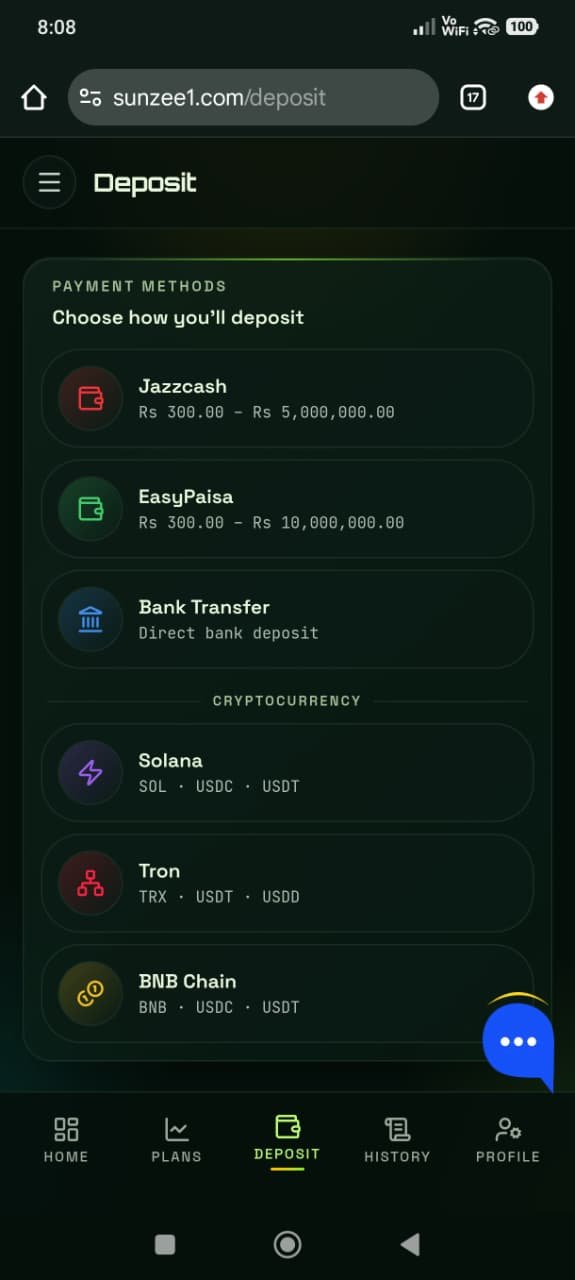
Why these exact payment methods
The choice of rails is not about convenience for you — it’s about permanence for them. Each option is picked because it is hard or impossible to reverse.
JazzCash & EasyPaisa
Mobile-wallet transfers settle instantly and are treated like cash. Once you’ve sent money to the operator’s number, there is no “dispute” button and no bank that will reverse it for you. Often the deposit instructions route through personal or agent numbers that change frequently, so by the time one is reported, the money has already moved on.
Bank transfer
A direct transfer to an account you don’t control is equally final. Scam operations commonly use “mule” accounts — opened in others’ names — so even a police trace lands on a person who was themselves used, while the funds are long gone.
Cryptocurrency (USDT, etc.)
Crypto is the scammer’s favourite because it is irreversible by design. There is no bank, no chargeback, and no central authority that can undo a confirmed transaction. The FTC repeatedly warns that crypto payments to “investment” platforms are a classic scam pattern precisely because the money cannot be recovered once sent. Sunzee1 offering USDT on multiple chains isn’t sophistication — it’s an escape route for the operator.
The illusion after you deposit
The instant your transfer clears, your Sunzee1 dashboard updates. A balance appears; the live counter starts ticking up your “earnings.” It feels like your money is now working. It isn’t. That number is a value in a database the operator fully controls — it can be increased, frozen, or zeroed at will. You do not own it; you are shown it. The only real money in the entire system is the cash you sent and the cash other victims send.
How the deposit grows into a disaster
Deposits rarely stay at Rs 300. The design nudges you upward: a small deposit “earns,” a small withdrawal is paid, trust builds, and then the maths whispers that a bigger deposit means bigger hourly income. People re-invest their “profits,” then their savings, then borrow. Because the early experience was genuinely positive (by design), the larger deposits feel rational. This is how victims who could afford to lose Rs 300 end up losing lakhs.
If you already deposited
- Try to withdraw the full balance now, while early withdrawals may still be honoured. Take what you can, immediately.
- Never pay a “fee,” “tax,” or “activation” charge to release funds — that is throwing good money after bad.
- Save every record: transaction IDs, the receiving numbers/wallets, screenshots, dates and amounts.
- Report the receiving account to your wallet provider (JazzCash/EasyPaisa) and to the FIA Cyber Crime Wing. Fast reporting occasionally allows a mule account to be frozen.
- Stop recruiting and warn anyone you brought in.
Why “just test it with small money” fails
The most common way careful people talk themselves into a scam is the small test. “I’ll only put in Rs 500. If it works, I’ll add more; if not, I’ve lost almost nothing.” It sounds rational. It’s exactly the reasoning the scheme is built to exploit, and here’s why it backfires:
- The small test is designed to succeed. Early, low-value withdrawals are usually honoured precisely so your “test” returns a positive result. You’ve now run an experiment the operator rigged, and concluded the platform is trustworthy.
- Success moves the anchor. Once the test “passes,” the safe amount in your mind jumps from Rs 500 to Rs 50,000. The scheme doesn’t need you to lose the test — it needs the test to convince you to make a real deposit.
- You become a live testimonial. A successful small withdrawal turns into a screenshot you share, recruiting others and deepening your own commitment.
- The real loss is timed to your confidence. By the time you deposit an amount that hurts, you’re past the point where you’re watching for red flags.
The honest way to think about it: a scheme engineered to collapse has no safe entry amount, because the amount that matters is the one you’ll deposit after it earns your trust — not the one you deposit to test it.
Crypto, explained in plain terms
Sunzee1 accepts USDT and other coins across Solana, Tron and the BNB Chain, and it’s worth understanding why in simple language, because the crypto option traps people who assume “digital = modern = safe.”
When you pay with a bank card, a hidden safety net exists: if the merchant is fraudulent, your bank can often reverse the charge. Mobile wallets like JazzCash and EasyPaisa have weaker protection but at least a company you can report to. Cryptocurrency has none of this. A confirmed crypto transaction is final and permanent — there is no bank, no company, and no authority anywhere on Earth that can undo it or force a refund. The coins move from your wallet to the operator’s wallet, and that’s the end of the story.
For a scammer, that’s the ideal payment method: fast, borderless, hard to trace, and impossible to reverse. This is exactly why the FTC repeatedly warns that being asked to pay an “investment” platform in crypto for guaranteed returns is one of the clearest signals of fraud. Sunzee1 offering multiple crypto chains isn’t a sign of technical sophistication — it’s the operator installing an exit door for your money.
A realistic loss timeline
Here is how a Sunzee1 deposit journey commonly plays out, compressed. Recognising the shape early is what saves people.
Rs 500 test deposit
Balance appears; the counter starts ticking. It feels real.
Rs 300 withdrawal succeeds
Trust locks in. You screenshot it and tell a friend.
Rs 25,000 deposit
“It works — why start small?” You reinvest and add savings.
You recruit family
Their deposits pour in; your “commission” grows on screen.
Big withdrawal blocked
“Pay 10% withdrawal tax first.” The wall arrives.
Site goes quiet, then dark
Balances vanish. You, and everyone you referred, are out.
Every deposit along that path felt reasonable in the moment, because the previous step had “proven” the platform. That’s the trap: the deposit page doesn’t take your money all at once — it takes it one justified step at a time.
Where your deposit actually goes
It helps to picture the journey of your money once you press send, because it explains why recovery is so hard. In a scheme like this, your deposit typically doesn’t land in a company account at all. It flows into personal or “agent” mobile-wallet numbers, or crypto wallets, that the operator controls and rotates frequently. From there it is quickly moved, split, converted between wallets and coins, or cashed out — a process that puts distance between your rupee and any name a complaint could pin down.
The receiving numbers are often mule accounts: wallets or bank accounts opened in the names of other people, sometimes themselves deceived or paid a small fee to “rent” their identity. So even when a transaction is traced, it lands on someone who was used as a layer, while the real operator stays hidden behind them. This structure is deliberate. It’s why acting fast matters — the sooner a receiving number is reported, the higher the (still small) chance of a freeze before the money moves on.
If you deposited: reporting, step by step
- Screenshot everything immediately — the deposit confirmation, the receiving number or wallet address, the amount, date, and any chat with “support.” Evidence fades as scam sites go dark.
- Contact your wallet/bank right away. Call JazzCash/EasyPaisa or your bank’s helpline, report the recipient as fraudulent, and ask them to flag or freeze it. Speed is everything here.
- File with the FIA Cyber Crime Wing. Submit your evidence at nr3c.gov.pk or a regional office. This is the body with authority over online financial fraud in Pakistan.
- Report the scheme to the SECP if it’s soliciting investment/deposits, at secp.gov.pk, so it can be added to warning lists.
- Warn your network and post a public review (for example on ScamAdviser) so others searching the name find the truth.
Deposit page FAQ
Is it safe to deposit a small amount “just to try” Sunzee1?
No. A small deposit is exactly what the scheme wants — it’s the hook. Small deposits are often paid back early to win your trust and pull you toward much larger ones. There is no “safe” amount to put into a scheme designed to collapse.
Can JazzCash or EasyPaisa reverse my Sunzee1 payment?
Mobile-wallet transfers are treated like cash and generally cannot be reversed once sent. You can and should report the receiving number as fraudulent, but do not count on recovery. Prevention is the only reliable protection.
Why does Sunzee1 accept USDT and other crypto?
Because crypto transactions are irreversible and hard to trace, which suits an operator planning to disappear. The FTC lists “pay us in crypto for guaranteed returns” as a hallmark of investment fraud.