Step 1 — The promise that hooks you
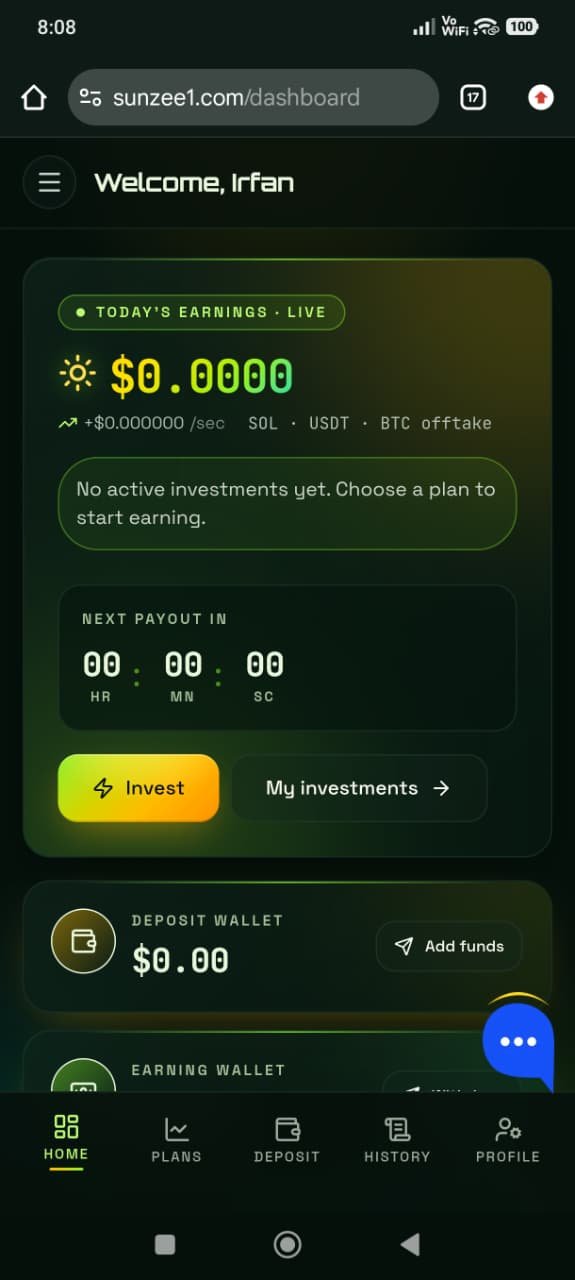
Every scheme like this starts with a number too good to walk away from. Sunzee1’s “Photon” plan advertises 0.1% profit per hour for 5,760 hours — presented as calm, automatic, guaranteed income from selling solar electricity. The homepage shows a live counter ticking up your “today’s earnings” by the second, a “next payout” countdown, and a friendly “Welcome, [your name]”. It is engineered to feel like a real fintech product, not a gamble.
But look at what is being promised: a fixed return, paid continuously, regardless of weather, markets, demand, or anything happening in the real world. Genuine investments — including real renewable-energy projects — never work like that. Their returns are variable, taxed, delayed, and never guaranteed. When something promises certainty where certainty is impossible, the certainty is the lie.
Step 2 — The maths that can’t be real
Let’s take the app at its word and do the arithmetic it avoids. 0.1% per hour equals 2.4% per day. Even ignoring compounding, that is roughly 876% simple return per year. With compounding it becomes astronomical — the kind of growth that, if it were real, would make Sunzee1 the most valuable company on Earth within a year. It isn’t, because the money to pay those returns does not come from selling electricity. It comes from the next person who deposits.
This is the defining feature of a Ponzi scheme: returns to earlier participants are paid out of the capital of later participants, not from any genuine profit. The US Securities and Exchange Commission defines it exactly that way, and lists “high returns with little or no risk” and “overly consistent returns” as the top warning signs. Sunzee1 checks both boxes on its very first screen. (See the SEC’s Ponzi guide, linked below.)
Step 3 — Getting your money in (fast)
Once you believe the number, the app makes depositing effortless. The deposit page offers JazzCash and EasyPaisa from as little as Rs 300, plus bank transfer and several cryptocurrencies (USDT on BEP-20, Solana, Tron). Two things about this are deliberate:
- Low entry, high ceiling. A Rs 300 minimum removes hesitation and lets anyone “test” it. The multi-million rupee ceiling exists for when you’re hooked and ready to go all-in.
- Irreversible rails. Mobile-wallet transfers and crypto are near-impossible to claw back. Once you press send, the operator has your money and you have a number on a screen. There is no chargeback, no bank dispute, no undo.
We walk through this screen in detail on the deposit page breakdown. The short version: everything about it is optimised to move money toward the scammer as quickly and permanently as possible.
Step 4 — Building false trust
Here is the part that fools smart people. In the early weeks, Sunzee1 actually pays. You withdraw a small amount, it arrives in your JazzCash, and now you’re a believer. You post a screenshot. Your cousin joins. This isn’t a glitch — it’s the strategy. Paying out small, early withdrawals using other members’ deposits is how the scheme buys credibility and free advertising. The “proof” circulating on WhatsApp and YouTube is manufactured bait.
Step 5 — Turning you into a recruiter
A plain Ponzi runs out of new deposits quickly. Sunzee1 solves that by paying you to bring others in. Its referral system offers commission across five levels — you earn on your direct recruits, and on their recruits, and so on, described as “lifetime earnings.” This is a pyramid structure, and it is the accelerant on the fire.
Once you’re earning from recruitment, you stop scrutinising the platform and start defending it, because your income now depends on more people joining. You pull in family, coworkers, and your mosque or community group. The scheme spreads through trust networks, which is why it does so much social damage. We break the numbers down on the referral trap page.
Crucially, in Pakistan this isn’t just unethical — it’s illegal. The SECP has stated repeatedly that referral marketing, MLM, pyramid and Ponzi schemes that raise public deposits are unlawful under Section 301 of the Companies Act, 2017.
Step 6 — The withdrawal wall
The turn comes when you try to take out a meaningful amount. Suddenly the smooth machine develops friction. Common patterns in schemes of this type include:
- A surprise “withdrawal tax”, “account activation fee”, or “anti-money-laundering deposit” you must pay first — designed to extract even more before you realise the truth.
- A raised minimum withdrawal, or a rule that you must “invest more to unlock” your balance.
- Withdrawals stuck as “pending” indefinitely, with support that stops replying.
- “Verification” loops that never complete.
If a platform asks you to pay a fee to release your own money, it is a scam, full stop. Paying it never releases the funds — it just adds to your losses. Real financial services deduct fees from your balance; they never demand a fresh deposit to let you withdraw.
See the mechanics on our withdraw page breakdown.
Step 7 — The collapse
Because deposits must always exceed withdrawals for the scheme to survive, the moment recruitment slows the math turns fatal. What happens next is predictable:
Withdrawals “pause”
Framed as “server upgrade,” “bank maintenance,” or “high demand.” It’s the exit beginning.
New fees appear
Last-minute “taxes” squeeze the final rupees out of hopeful members.
The site goes dark
The domain — often only weeks or months old — simply disappears, taking every balance with it.
Sometimes it “rebrands”
The same operators relaunch under a new name and logo, and the cycle starts again with fresh victims.
ScamAdviser notes this openly: scam sites are typically young and are pulled offline after a few months once negative reviews pile up — but they keep operating until then, trying to take as much as they can.
The psychology it uses on you
None of this works without exploiting normal human instincts. Sunzee1 leans on several:
- Greed and FOMO — “others are already earning; don’t miss out.”
- Social proof — payout screenshots and YouTube “reviews” (often by paid promoters using their own referral links).
- Small, safe first step — a Rs 300 minimum lowers your guard.
- Sunk-cost pressure — once you’ve deposited and recruited, admitting it’s a scam feels harder than depositing more.
- Authority mimicry — a polished, professional interface borrows the look of a legitimate fintech to borrow its trust.
The real cost, beyond the money
It’s tempting to measure a scheme like Sunzee1 only in rupees lost, but the damage usually runs deeper, and naming it honestly helps people take the risk seriously before they’re in it.
Debt that outlasts the scheme. Because the platform pays small amounts early and promises so much more, people don’t just risk savings — they borrow. They take committee (BC) money, loans from relatives, or advances against a salary, planning to repay from “profits” that never arrive. When the site vanishes, the debt stays, sometimes for years.
Fractured relationships. The referral engine turns the loss into a shared one. The cousin who recruited you, the friend you recruited — everyone in the chain feels betrayed or guilty. Money borrowed from family and lost to a scam can strain bonds that mattered far more than the cash.
Shame and silence. Many victims never report, because admitting they were fooled feels worse than the loss itself. That silence is exactly what lets the operators move on to the next town and the next scheme. There is no shame in being targeted by professionals who engineer these traps for a living — but the feeling is real, and it keeps people quiet.
Repeat victimisation. Once your details are on a “people who deposited” list, you become a target for the next scheme and for fake “recovery” services. One loss can quietly lead to another if you don’t lock things down afterward.
Seeing these costs clearly is protective. The Rs 300 “test” doesn’t look so harmless when you picture where the path actually leads: borrowed money, broken trust, and a silence that helps the scheme survive. The way to avoid all of it is upstream — at the decision to deposit, which is the one moment you fully control.
Variations you might see (same trap, new paint)
Operators tweak the surface to stay fresh and dodge warnings, but the machinery underneath doesn’t change. If Sunzee1 disappears, expect to meet its cousins wearing different themes. Watch for these familiar shapes:
- Different “industry,” same promise. Solar today; tomorrow it’s AI trading bots, oil, gold, e-commerce “tasks,” or a mining farm. The story is set dressing — the fixed guaranteed return is the constant.
- “Daily task” or “watch ads to earn” apps. A gamified layer that pays trivial amounts, then upsells a paid “VIP plan” to “increase earnings.” The paid tier is the deposit trap.
- Rebrands and clones. When a scheme collapses, the same operators often relaunch with a new name, logo and domain, sometimes messaging the old user list directly.
- Celebrity or brand impersonation. Fake endorsements or logos of banks, telecoms, or well-known figures, added to borrow credibility the operator hasn’t earned.
- “Government-approved” claims. Invented licences or forged certificates. Always verify licensing at the regulator’s own site, never trust a claim shown inside the app.
The lesson: don’t memorise Sunzee1 as a single bad website — learn the structure (guaranteed returns + deposits + recruitment + irreversible payments + anonymity) so you recognise the next one instantly, whatever it’s called.
How to protect yourself and others
- Never deposit. No amount is “safe” in a scheme built to collapse.
- Never pay to withdraw. That request alone confirms fraud.
- Verify the regulator, not the website. Check whether the operator is licensed by the SECP to take deposits. Sunzee1 is not.
- Reverse the maths. If a return sounds impossible, it is — treat the promise itself as the warning.
- Warn your network loudly. The referral model spreads through trust; break the chain by telling family and friends before they join.
Sunzee1 doesn’t generate wealth — it redistributes it from newer victims to earlier ones and to the operators, until it collapses. The safest possible return from it is the money you never put in.