What the register page looks like
Almost every Sunzee1 promotion — the YouTube “reviews,” the WhatsApp forwards — shares a link that looks like sunzee1.com/register?ref=XXXXXXX. That ?ref= tag is not decoration. It stamps you as the recruit of whoever shared it, wiring you into the pyramid before you’ve typed a single character. The form itself typically asks for a name, a phone number or email, a password, and confirmation of that referral code.
It is deliberately quick and familiar — the same friction-free sign-up you’d expect from a real app. That familiarity is borrowed trust. A polished onboarding flow makes people assume there’s a real, accountable company behind it. With Sunzee1, there is no named company, no physical address, and no regulator standing behind that form.
The three things registration takes
1. Your personal data
At minimum you hand over a working phone number and often an email — contact details that go straight into the operator’s database. Gridinsoft’s scan explicitly notes that sunzee1.com runs data-collection forms requesting names, emails and phone numbers, and warns users to verify legitimacy before submitting anything. In scam ecosystems, that contact data has value beyond this one site: it can be re-used to target you with future schemes, sold to other fraud operators, or used in follow-up “recovery” scams after the platform collapses.
2. Your place in the pyramid
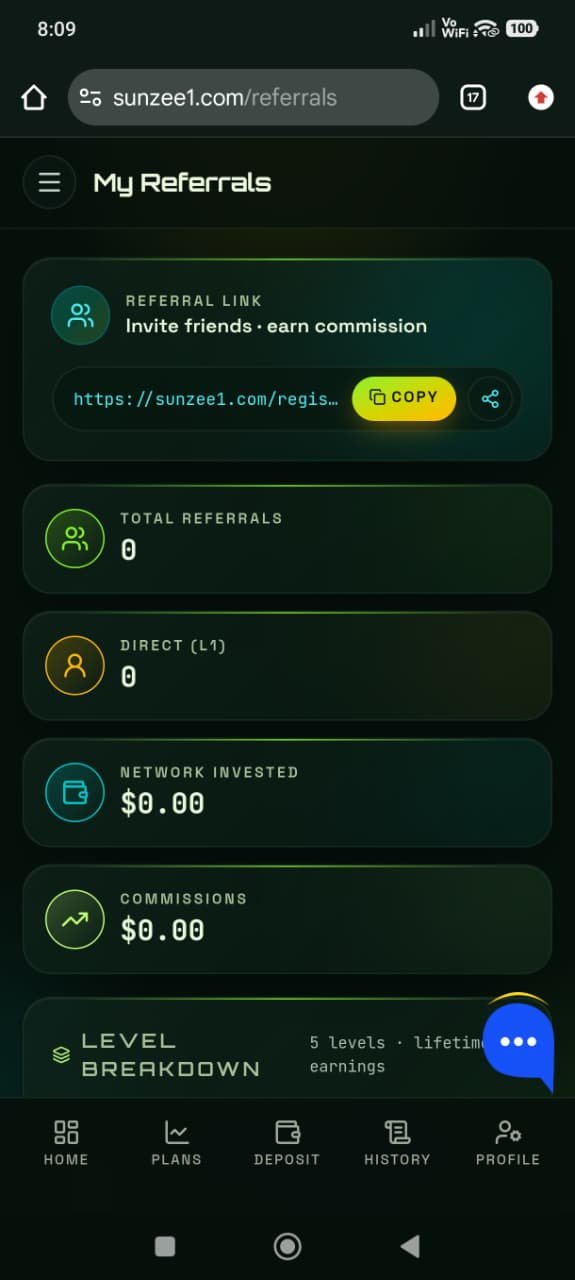
The referral code binds you to an upline. From that instant, a share of everything you deposit is credited as “commission” to the people above you, across up to five levels. You didn’t agree to fund anyone — but the structure quietly makes you someone else’s income stream the moment you join. We map this out on the referral trap page.
3. Your commitment
Psychologically, creating an account is the first “yes.” Behavioural research on fraud shows that each small step — register, verify, deposit Rs 300, recruit one friend — makes the next step feel natural, and makes walking away feel like admitting a mistake. The register page is designed to get that first easy yes so the harder ones follow.
“But registration is free — where’s the harm?”
This is the most dangerous misunderstanding. Free entry is the whole strategy. A zero-cost sign-up removes every reason to say no, gets you inside where the live counters and countdowns start working on you, and adds your phone number to a list. The harm isn’t in the sign-up fee (there isn’t one) — it’s in what the sign-up is engineered to lead to: your first deposit, then your recruitment of others.
If you already registered
- Do not deposit. An account with a zero balance has cost you nothing yet. Keep it that way.
- Change any reused password on your email, bank and wallet apps.
- Ignore “bonus” and “activation” prompts. Free credits that require a deposit to “unlock” are the hook, not a gift.
- Warn whoever referred you, and anyone you may have referred, before money changes hands.
Anatomy of a Sunzee1 referral link
Because almost everyone arrives through a shared link, it’s worth understanding what that link actually contains and why it matters. A typical Sunzee1 invite looks like this:
Everything after the question mark is a tracking parameter. The ref value is a unique code tied to one specific member’s account. When you open that link and register, the platform permanently records that this person recruited you, which means a share of your future deposits is routed to them and their upline. You never see this happen; it’s baked into the URL. There is no version of the link that doesn’t enroll you into someone’s downline, because recruitment tracking is the entire reason the link exists.
This is a useful tell you can apply to any platform. When a “great earning opportunity” only ever reaches you as a personalised referral link — from a relative, a YouTuber, a WhatsApp group — and the platform rewards the sharer for your sign-up, you are looking at a recruitment-driven scheme, not a product people buy because it’s good. Genuine services are recommended because they work; pyramids are recommended because the recommender gets paid.
How a legitimate sign-up looks different
It helps to contrast Sunzee1’s onboarding with how a real, regulated financial service registers you. The differences aren’t cosmetic — they reflect whether anyone is actually accountable for your money.
- Identity of the company is front and centre. A legitimate platform tells you the registered company name, its incorporation details, and a verifiable physical address. Sunzee1 offers none of this — you cannot name the company you’re “investing” with.
- Regulatory licensing is stated and checkable. Real deposit-taking or investment firms display licence numbers you can verify with a regulator like the SECP or State Bank. Sunzee1 shows no such licence, and the SECP has warned that collecting public deposits without authorisation is illegal.
- Risk is disclosed, not hidden. Honest platforms are legally required to tell you that returns vary and that you can lose money. Sunzee1 does the opposite — it promises fixed, guaranteed hourly profit, which no honest investment can.
- Real identity verification serves you, not the scam. Legitimate KYC exists to protect your account and comply with law. On scam platforms, any “verification” tends to appear later, as an excuse to extract more money before a withdrawal.
- You’re not recruited at sign-up. Opening a bank account doesn’t immediately hand you a “refer and earn 5 levels” dashboard. Sunzee1 does, because recruitment is its lifeblood.
What happens to your data after you register
People underestimate the value of the “small” data a sign-up form collects. To a scam operator, your verified phone number and email are an asset in their own right, separate from any deposit. Here’s how that data is typically used in scam ecosystems:
- Retargeting inside the scheme. Your number feeds automated “bonus available!” and “your earnings are waiting” messages designed to pull you from registration to deposit.
- Resale to other fraud operators. Lists of people who signed up for one “earning app” are gold to the next one — you’ve already shown interest. Expect more scheme invitations after joining.
- Follow-up “recovery” scams. After a platform collapses, its user list is precisely who gets targeted by fake “fund recovery agents” demanding an upfront fee. Your registration data is what makes you findable.
- Credential-stuffing. If you reused a password, that email-and-password pair may be tried against your bank, wallet and social accounts.
This is why “I only registered, I didn’t deposit” still deserves a small defensive response: change any reused password, be sceptical of new “earning” invitations that arrive afterwards, and never act on a message claiming your account has bonuses to unlock.
A 30-second checklist before you register anywhere
- Does it promise fixed or guaranteed returns? → Walk away.
- Did it reach you as a personal referral link that pays the sharer? → Be very sceptical.
- Can you name the licensed company and verify it with a regulator? → If not, don’t sign up.
- Does it push you to recruit others to earn? → That’s a pyramid.
- Is the website brand-new and anonymous? → Check it on ScamAdviser first.
Sunzee1 fails all five. Any single failure is reason enough to close the tab; failing all five is as clear a warning as the internet gives you.
Just signed up? Your first 10 minutes
If you registered a moment ago and this page is your reality check, good — you’ve caught it at the cheapest possible point. Here’s a calm, ordered response before any money is involved:
- Do not deposit anything. Not Rs 300, not a “bonus activation” amount. A zero-balance account is a loss of nothing. Keep it that way and the scheme has taken no money from you.
- Ignore every prompt that leads to a deposit. “Claim your welcome bonus,” “activate your plan,” “your earnings are waiting” — all are funnels toward the one action that costs you. Close them.
- Secure any reused password. If the password you used exists on your email, bank, or wallet, change those now to unique passwords. Assume the scheme’s database is not safe.
- Turn off notifications from the app/site so its urgency messaging can’t work on you over the coming days.
- Tell whoever sent you the link what you’ve learned, kindly. They may be a victim too, unaware they’re recruiting into a trap.
That’s it. Registration without deposit is a near-miss, not a catastrophe. The single most valuable thing you can do now is make sure the “first deposit” never happens — yours or anyone’s you might have invited.
Teach the next person to spot it
The people most likely to fall for the sign-up are those who’ve never had it explained. A one-line habit protects them: “Before you register anywhere that touches your money, find the licensed company name and check it with the regulator — if you can’t, don’t sign up.” Pair that with the referral-link tell (a personal ?ref= link that pays the sharer is a recruitment scheme, not a recommendation), and you’ve given someone a defence that works not just against Sunzee1 but against every clone that follows it. Passing on that recognition is the opposite of a referral link — it costs you nothing and it protects the person instead of preying on them.
Register page FAQ
Is it dangerous to register on Sunzee1 without depositing?
Registering without depositing costs no money, but you do hand over contact data and enter the referral structure. The real risk begins if the app’s incentives push you toward depositing. If you registered, simply never deposit — and change any reused password.
Do I need a referral code to join?
Most Sunzee1 links carry a referral code so the sharer earns commission on your activity. Whether or not a code is “required,” its presence tells you the platform’s growth depends on recruitment — a core pyramid trait.
Can I delete my Sunzee1 account and data?
Anonymous scheme operators rarely honour deletion requests, and there’s no regulator forcing them to. Assume any data you submitted is retained. The practical protection is to not submit sensitive data in the first place and to secure accounts that share a password.