The verdict at a glance
After reviewing how the platform works end to end — sign-up, deposit, the “earnings” dashboard, withdrawals, and the referral system — and cross-checking against independent website scanners and regulator guidance, our assessment is unambiguous. Sunzee1 is best treated as an unsafe, likely fraudulent scheme, and the responsible recommendation is to keep your money out.
Numbers like the trust score and domain age come from independent tools you can run yourself (linked below). The “scam signals” count refers to the six classic markers we describe next — Sunzee1 exhibits all of them.
The evidence: six red flags
Guaranteed hourly returns
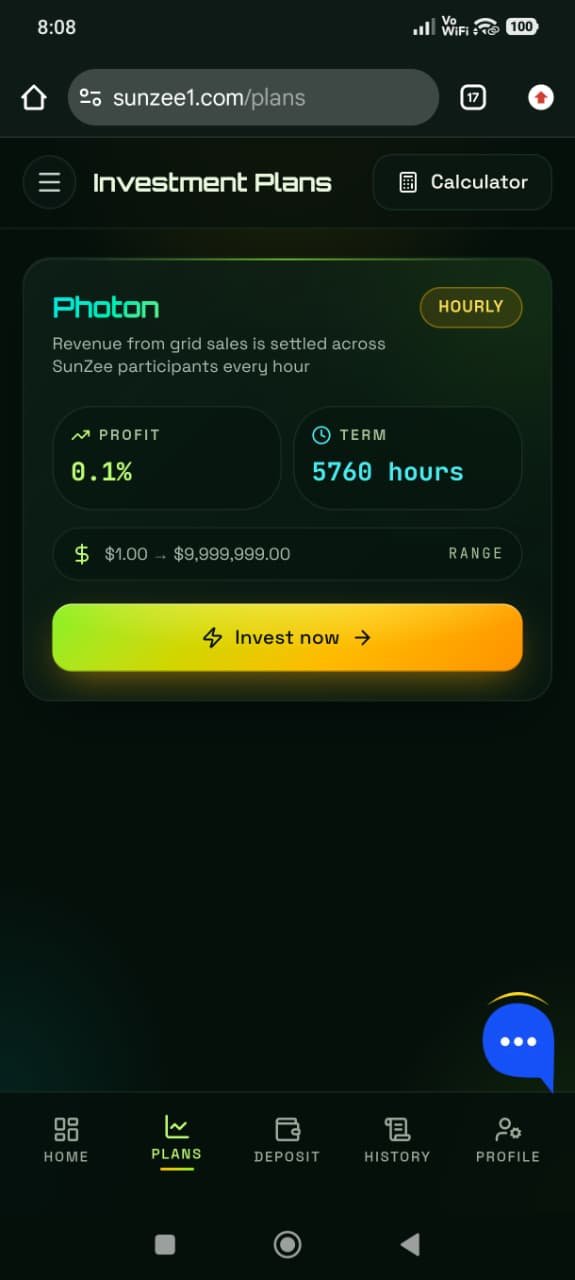
A fixed ~0.1% per hour (~2.4%/day) is a mathematical impossibility for any honest, variable investment.
Deposit-first, refund-proof
Money in via JazzCash, EasyPaisa and USDT crypto — rails deliberately chosen because they can’t be reversed.
5-level referral pyramid
“Lifetime” commission for recruiting recruits — the defining feature of a pyramid scheme.
Anonymous operator
No named company, no registered address, no team — no one you can hold accountable.
No licence
No SECP/SBP authorisation to collect public deposits, which regulators say is required and unlawful to skip.
Brand-new, low-trust domain
A very young website with low popularity and a poor independent trust score.
No single flag is proof on its own — but scams rarely announce themselves with one giant sign. They reveal themselves through a cluster of smaller ones. Sunzee1 shows the entire cluster with unusual completeness, which is what moves this from “be cautious” to “avoid.”
Why the “profit” can’t be real
The clearest tell is the maths. A promised 0.1% per hour compounds to roughly 2.4% per day — a rate that would turn a small sum into a fortune within months if it were real. No legitimate business generates guaranteed returns at that scale; if any did, it wouldn’t need Rs 300 deposits from the public advertised through WhatsApp referral links. When a platform’s advertised returns are impossible from real economic activity, the money being “paid out” can only be coming from somewhere else — namely, the deposits of newer members. That is the literal definition of a Ponzi scheme, and it’s why these platforms must keep recruiting to survive and inevitably collapse when recruitment slows.
What independent scanners say
You don’t have to take our word for it — several neutral tools reach the same conclusion, and you can run them yourself in a minute:
- ScamAdviser assigns sunzee1.com a very low trust score and highlights risk factors such as the site’s young age and low traffic.
- Gridinsoft’s scanner flags the domain as suspicious and notes its data-collection forms, advising users to verify legitimacy before submitting personal information.
- Regulator guidance matches the pattern: the US SEC lists “guaranteed high returns with little risk,” “unregistered operators,” and “difficulty receiving payments” as core Ponzi warning signs — all present here.
When independent security scanners and financial regulators, none of whom benefit from your decision either way, all point the same direction, that consensus deserves more weight than any glossy testimonial.
How to read the “positive reviews”
Search the name and you’ll find upbeat videos, glowing comments and screenshots of withdrawals hitting JazzCash. It’s important to know how to weigh these, because they’re engineered to be persuasive:
- Many reviewers are paid promoters. If a “reviewer” shares a referral link, they earn when you join — their review isn’t neutral, it’s marketing.
- Early payouts are real but funded by victims. A genuine screenshot of a small early withdrawal doesn’t prove sustainability; it proves you’re watching the bait stage of the cycle.
- Survivorship bias makes winners loud. The handful profiting early post constantly; the majority who lose later mostly stay silent out of embarrassment.
- Timing tells the story. Positive proofs cluster near launch; the absence of “I withdrew a large amount after two months” stories is itself a signal.
What the real user experience tends to look like
Across schemes of this exact shape, the lived experience follows a predictable arc. A user deposits a small “test” amount and successfully withdraws a little, which builds trust. Encouraged, they deposit far more and begin recruiting family and friends, whose deposits swell the on-screen “commission.” Then, when they try to withdraw a meaningful sum, the wall appears — a “tax” or “fee” demanded up front, an endlessly “pending” status, or shifting rules. Eventually the site slows, support goes quiet, and the domain goes dark. The people hurt most are not the earliest entrants but the late majority, and — painfully — the friends and relatives they were persuaded to bring in. Recognising this arc early is what lets you step off it before the expensive part.
Why smart, careful people still get caught
It’s a mistake to think only the naïve fall for this. These schemes are engineered by professionals to defeat ordinary caution: the small successful withdrawal disarms scepticism, the trusted friend who recruits you lends it credibility, and the polished app borrows the feel of legitimate fintech. Add real financial pressure and the promise of easy income, and the trap is well set. If you’ve been tempted, that’s not a character flaw — it’s evidence the scheme is doing what it was built to do. The defence isn’t being “smart enough,” it’s recognising the structure and refusing on principle.
How we assessed Sunzee1
So you can judge the reliability of this verdict, here’s the method behind it. We examined the platform’s own user journey end to end — registration, the deposit options, the earnings dashboard, the withdrawal process, and the referral system — and compared what we found against two independent benchmarks: neutral website-reputation scanners, and the published warning-sign frameworks of financial regulators. We looked specifically for the features that distinguish a real investment from a Ponzi/HYIP scheme: whether returns are guaranteed or variable, whether an accountable licensed company stands behind the money, whether payments in and out behave normally, whether growth depends on recruitment, and whether the operator is identifiable. We did not rely on promotional videos or testimonials, because those have an obvious incentive problem. Where we cite a figure — a trust score, a domain age — it comes from a tool you can run yourself, linked on this page. This isn’t a legal ruling; it’s a documented, evidence-based assessment intended to help you make a safer decision.
Sunzee1 vs. a legitimate investment
Laid side by side, Sunzee1 sits opposite a real investment on every line that matters:
- Returns: real investing offers variable returns and openly warns you can lose money; Sunzee1 promises a fixed, guaranteed hourly profit that can’t exist honestly.
- Source of profit: a real business earns from selling a product or service; Sunzee1’s payouts track new deposits, not any verifiable revenue.
- Accountability: legitimate firms are named, licensed, and answerable to a regulator; Sunzee1 is anonymous and unlicensed.
- Growth: a real service grows because customers value it; Sunzee1 grows by paying members to recruit.
- Getting paid: real platforms honour withdrawals on stated terms; Sunzee1 pays small early amounts, then blocks larger ones behind fees.
Whenever a platform sits on the wrong side of these lines — guaranteed returns, anonymous operator, recruitment-driven growth, easy in and hard out — you don’t need to recognise its name to recognise its type. Sunzee1 is a textbook example.
Who is most at risk
These schemes deliberately target people for whom easy income is hardest to refuse: students, homemakers, daily-wage earners, job seekers, and anyone under financial strain. The low entry amount is chosen so that people with little to spare feel they can afford to try — and they’re the ones who can least afford to lose. Because Sunzee1 spreads through trusted relationships, it also concentrates harm: when it reaches a family or a neighbourhood, it can take many people at once, since the person who recruited you is someone you believe. If that describes you or someone you love, the protective step is the same and it’s free — don’t deposit, and warn the next person before they do.
Why acting on this review early matters
With schemes of this kind, timing is everything, and it runs against you. The longer the platform stays up, the more convincing it looks — early payouts, growing “balances,” friends who seem to be earning — and the deeper people commit right before the collapse. That means the safest moment to act on a review like this is always now, while your exposure is smallest: before the first deposit, or before the next one. Waiting for “more proof” usually just means waiting until you’ve deposited more and recruited more. If this review has reached you early, that’s the advantage — use it. Keep your money out, don’t pull anyone else in, and pass the warning along while it can still change someone’s decision.
Sunzee1 review FAQ
Is Sunzee1 real or fake?
On the evidence, fake. It shows every hallmark of a Ponzi/HYIP scam: guaranteed hourly profit, deposit-first design on irreversible rails, a five-level referral pyramid, an anonymous operator, no licence, and a brand-new low-reputation domain flagged by independent scanners.
Is Sunzee1 legit or a scam?
Our assessment is that it is not legitimate. There’s no named, licensed company, no authorisation to take public deposits, and the returns track new deposits rather than any real business — the definition of a Ponzi scheme. We recommend not depositing.
People are showing payment proofs — doesn’t that prove it pays?
Early, small payouts are common and are funded by later members’ deposits; they don’t prove sustainability. Many “proofs” also come from promoters earning referral commission. The question that matters is whether large balances will still be paid next month — and the structure says no.
What should I do if I already invested?
Withdraw whatever you can right now, add nothing more, never pay a fee to “release” a withdrawal, save your evidence,