What Sunzee1 offers recruiters
Open the referrals screen and you’re handed a personal invite link, a running count of your “team,” and a “Level Breakdown” panel advertising five levels of commission described as lifetime earnings. In plain terms: you earn a cut when the people you recruit deposit, and a smaller cut when their recruits deposit, and so on down five layers. The more your network deposits, the more you’re paid.
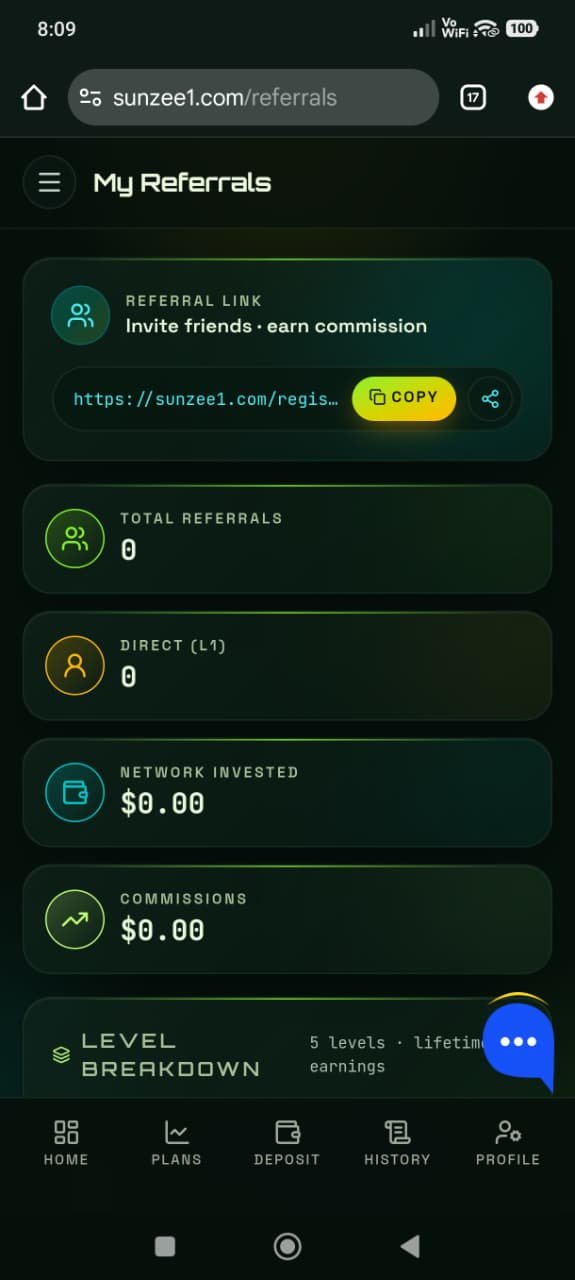
Why the pyramid is the most dangerous part
A pure Ponzi has a fatal weakness: it needs a constant flow of new deposits, and cold strangers are hard to convince. The referral system solves this by weaponising trust. When your uncle, your colleague, or a respected community figure invites you, you don’t scrutinise a website — you trust a person. That’s why schemes like Sunzee1 pour so much design into recruitment. It lets the fraud travel along relationships instead of advertising, reaching people who would never have joined on their own.
It also changes you. The moment your income depends on recruitment, you stop asking whether it’s a scam and start persuading others it isn’t. Victims become promoters; promoters recruit new victims. This is how a single scheme drains an entire extended family or neighbourhood — and why the guilt afterwards is so heavy, because the people you lost money for are people you love.
The maths of impossible growth
Pyramids sell themselves with a fantasy of exponential team growth: “just refer 3 people, get them to refer 3 each…” Follow that to five levels and you’d supposedly sit atop hundreds of paying recruits. But exponential growth hits a wall fast — there aren’t enough new people, and each layer needs the one below it to keep expanding. Mathematically, the overwhelming majority of participants in any pyramid must end up in the losing lower layers. The tiny number at the top who profit do so directly at the expense of everyone beneath them.
If you’ve been recruiting
- Stop sharing your link today. Every new recruit is someone who will likely lose money you helped attract.
- Tell the people you referred the truth — quickly, before they deposit more or recruit further. An awkward message now prevents a much larger loss later.
- Don’t “make it back” by recruiting harder. That only deepens the harm and your exposure.
- Warn your wider circle. Breaking the trust chain is the single most effective way to stop this scheme spreading.
A worked example of the 5-level illusion
Pyramids sell a dream that collapses the moment you put numbers to it. Suppose the pitch is “just get 3 people to join, and teach them to do the same.” Follow that promise down Sunzee1’s five levels:
- Level 1: you recruit 3 people.
- Level 2: they each recruit 3 → 9.
- Level 3: 27.
- Level 4: 81.
- Level 5: 243.
For your network alone to “complete,” 363 people must deposit beneath you. But every one of those 363 is being sold the same dream, so each of them needs their own 363 below them. Extend that just a few more layers and the required number of new recruits exceeds the population of entire cities, then countries. The growth the pitch depends on is physically impossible to sustain, which means the vast majority of participants — everyone who joins after the early wave — mathematically cannot be in profit. They are the base of the pyramid whose deposits paid the few at the top. This isn’t bad luck or poor timing; it’s arithmetic baked into the structure.
Why the success stories mislead you
The handful of people genuinely making money early are real — that’s what makes them persuasive. But their success has a specific, temporary cause: they got in first and are being paid with the deposits of everyone recruiting beneath them. Their winnings are not evidence that the model works for participants; they are evidence that it transfers money from later participants to earlier ones. When the recruitment slows and the scheme collapses, even many early “winners” lose their remaining balances, and the late majority lose almost everything. A story that’s true today (“I withdrew Rs 40,000”) tells you nothing reliable about tomorrow, because the whole structure is a countdown to collapse.
How to talk your family out of it
If someone you love is already deep in Sunzee1 — recruiting, defending it, maybe planning a bigger deposit — arguing that “it’s a scam” often backfires, because their income and pride are now tied to it. A gentler, more effective approach:
- Ask questions instead of accusing. “Where does the profit actually come from?” and “Which licensed company is legally responsible for our money?” let them discover the gaps themselves.
- Focus on the withdrawal test, framed safely. Suggest they try to withdraw everything now, before adding more. A blocked or fee-gated withdrawal is more convincing than any lecture.
- Separate the person from the mistake. Make clear you’re not calling them foolish — these schemes are engineered by professionals to fool careful people. Shame makes people dig in; safety lets them step back.
- Give them an exit that isn’t humiliating. Stopping now and warning others is something to respect, not mock. Offer to help them draft the message to the people they referred.
Send this page — or any honest explanation — to one person who’s about to join. Breaking a single link in the trust chain can stop the scheme reaching an entire family. That’s the only kind of “referral” from Sunzee1 that actually helps anyone.
The exposure promoters don’t think about
People who recruit for schemes like Sunzee1 usually see themselves as participants, not culprits. But actively promoting a scheme that raises public deposits carries real exposure that’s worth understanding before you share another link.
Legal risk. The SECP has stated that referral marketing, MLM, pyramid and Ponzi schemes that collect public deposits are unlawful under Section 301 of the Companies Act, 2017, and it refers such matters to investigative authorities. Promoting one isn’t a neutral act; you’re helping distribute something regulators have declared illegal, and enthusiastic recruiters are not invisible in that chain.
Financial risk. Recruiters often deposit the most, because they believe hardest and reinvest their “commissions.” When the scheme collapses, the biggest promoter in a group is frequently the biggest loser too.
Relational and reputational risk. The people you recruited are people you know. When their money vanishes, the fallout lands on you personally in a way an anonymous operator never has to face. Your standing in your family, workplace, or community can take damage that long outlasts the money.
None of this is said to shame anyone — most recruiters were recruited themselves, in good faith. It’s said so you can make the genuinely protective choice: stop promoting now, and spend that same energy warning the people you were about to invite.
If you already recruited someone
Discovering you’ve pulled people you love into a scam is a heavy feeling, and the temptation is either to stay silent and hope, or to recruit harder to “earn it back.” Both make things worse. The repair is simpler and braver:
- Tell them promptly and plainly. “I think this is a scam and I don’t want you to lose money — please try to withdraw everything now and don’t deposit more.” Speed can save whatever they haven’t yet lost.
- Take responsibility without collapsing into shame. A simple “I shared this in good faith and I was wrong to” preserves the relationship far better than defensiveness or disappearing.
- Break the chain publicly. Warn the wider group you all belong to, so the scheme stops spreading through your network.
Owning a mistake early and helping others out of it is one of the more honourable things a person can do. It’s the exact opposite of what the scheme wanted from you — and it’s how the damage stops at you instead of multiplying through everyone you know.
Referral system FAQ
Is Sunzee1’s referral program legal in Pakistan?
No. The SECP has repeatedly stated that MLM, pyramid, Ponzi and referral schemes raising public deposits are unlawful under Section 301 of the Companies Act, 2017. Promoting Sunzee1’s referral program means promoting activity regulators have declared illegal.
Can I really earn “lifetime” commission from Sunzee1 referrals?
The “lifetime” label lasts exactly as long as the scheme does — typically weeks or a few months. When it collapses, commissions and balances vanish together, and the people you recruited lose their deposits.
I only shared my link, I didn’t deposit — am I responsible?
Whether or not you deposited, sharing the link helped pull others in. The ethical step is to warn everyone you referred immediately. Legally, promoting an unlawful scheme carries its own risks, so stop sharing and help the people you invited.