What the “Sunzee1 app” actually is
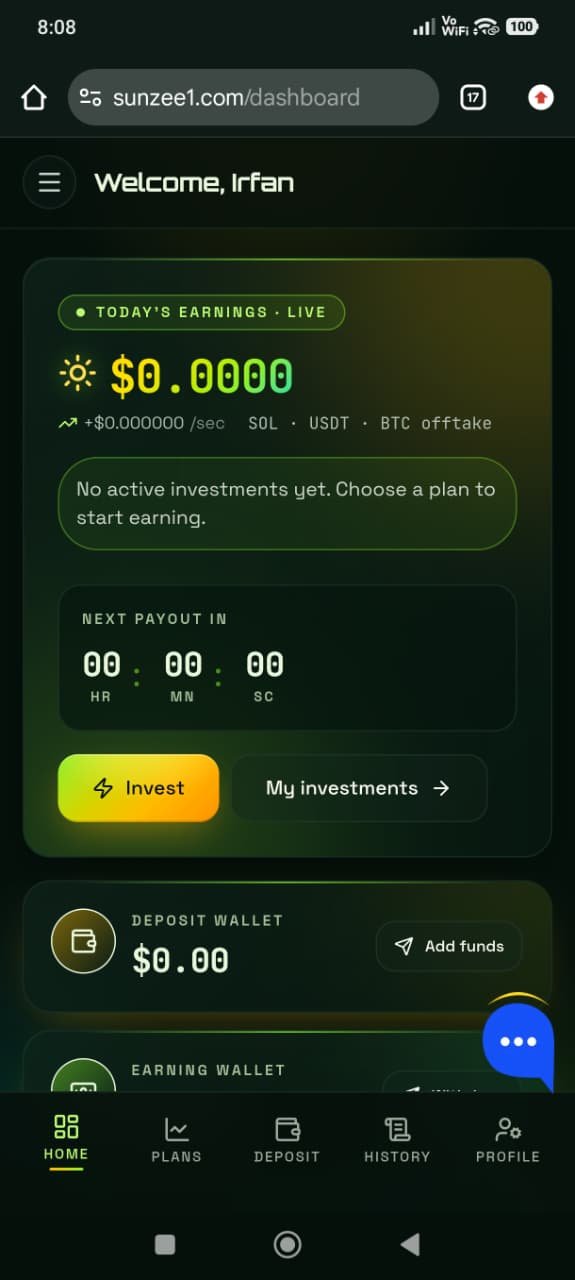
People imagine an “investment app” is a polished, vetted product from a real financial company. The Sunzee1 app is something much simpler: a front end — often a direct APK file or a lightweight web wrapper — that shows you a dashboard, an hourly-profit counter, a deposit button, a withdrawal button, and a referral panel. That’s essentially the whole product. There is no genuine solar business, trading engine or asset behind the numbers you see; the counter is just software incrementing a value on a screen.
This matters because the app’s polish is doing a job: it borrows the look and feel of legitimate fintech to make an anonymous scheme feel trustworthy. A smooth interface is cheap to build. Accountability — a licensed company, a real address, a regulator you can complain to — is what actually protects your money, and that is precisely what Sunzee1 does not have.
Why it isn’t a normal Play Store app
Schemes of this type are usually distributed as a direct .apk download or a “add to home screen” web app rather than a properly listed, reviewed app on Google Play or Apple’s App Store. That distribution choice is itself a warning sign, and it removes protections most people don’t realise they rely on:
- No store review. Official stores run automated and manual checks and can pull a fraudulent or malicious app. A raw APK skips that safety net entirely.
- No verified developer identity. Store listings tie an app to a developer account. An anonymous APK ties it to no one you can hold responsible.
- “Unknown sources” must be enabled. Installing a sideloaded APK usually requires you to switch off a security setting that exists specifically to stop untrusted software — lowering your phone’s defences for the exact kind of app you should trust least.
- Silent updates. A sideloaded app can change behaviour through updates you never see reviewed, so what’s “safe” today may not be tomorrow.
Google’s own security guidance and consumer regulators repeatedly caution against installing financial apps from outside official stores for these reasons. When an “earning app” can only be obtained as a direct file from a link in a WhatsApp group or a referral page, treat that as a red flag, not a convenience.
Why downloading it is risky even if the file is “clean”
It’s tempting to think “I’ll just install it and look around — I won’t deposit.” Two problems with that. First, the file and its permissions are a risk in their own right, as above. Second, and more importantly, the app is a persuasion machine. Once it’s on your phone, it goes to work:
- A live profit counter ticks upward to create a fear of missing out.
- Notifications nudge you daily — “your earnings are waiting,” “bonus expires soon.”
- A referral panel invites you to pull in friends and family before you’ve tested anything.
- Small “bonus” balances appear that can only be “unlocked” by depositing.
None of this requires you to have decided to invest. The app is designed to move you from curious to committed one tap at a time. Not installing it keeps you out of that funnel completely.
The warning signs behind the app
Strip away the interface and the platform the app connects to shows the textbook pattern of a high-yield investment scam:
Guaranteed hourly profit
A fixed ~0.1% per hour is a certainty no real, variable investment can offer.
Deposit-first design
Irreversible rails — mobile wallets and USDT crypto — chosen to prevent refunds.
5-level referrals
Rewards for recruiting recruits — the defining trait of a pyramid.
Anonymous operator
No named company, no address, no licence, no one accountable.
Brand-new domain
A very young, low-reputation website scored poorly by third-party scanners.
Off-store distribution
Delivered as a raw APK / web app that skips store vetting.
You can verify the domain side of this yourself in under a minute using ScamAdviser or Gridinsoft’s scanner. Both flag sunzee1.com as high-risk. For the underlying scheme type, the US SEC’s Ponzi guide lists the same signals: guaranteed returns, unregistered operators, and difficulty getting paid.
How to tell a real finance app from this
Use this quick contrast the next time any “earning app” is put in front of you:
- Store presence: a real app has a genuine, reviewed listing with a verifiable developer — not a link to a bare APK.
- Named, licensed company: you can find who runs it and confirm their licence with a regulator such as the SECP or State Bank of Pakistan.
- Honest risk language: real investing warns you that returns vary and you can lose money. Scam apps promise fixed profit.
- No recruit-to-earn: legitimate services don’t pay you commissions for signing up your relatives.
- Sensible permissions: the app asks only for what its stated function needs.
Sunzee1 lands on the wrong side of every line. That pattern — not any single feature — is what makes “don’t install” the right call.
Already downloaded or installed it? Do this now
- Don’t deposit a single rupee. An installed app with no deposit has cost you nothing yet. Keep it that way.
- Uninstall it and, on Android, re-disable “install from unknown sources.”
- Review permissions you may have granted (contacts, SMS, storage, accessibility) and revoke them.
- Change any reused password. If the password you set exists on your email, bank or wallet, change those to unique passwords now.
- Ignore every “bonus/activation” prompt. Credits that require a deposit to unlock are the hook, not a gift.
- Warn whoever shared the link — they may be an unwitting victim recruiting others.
A warning about “recovery” and “mod” downloads
Two follow-on scams cluster around searches like yours. First, fake “fund recovery” services that promise to get lost money back for an upfront fee — they simply take a second payment and vanish; no legitimate recovery service works that way. Second, “mod” or “hack” APKs claiming to unlock unlimited earnings — these are bait that deliver malware or steal whatever you deposit. Both prey on people already searching around this app. Don’t download either. The only genuinely safe path is out of the ecosystem entirely.
How the app reaches you — and why that matters
Notice how you heard about Sunzee1 in the first place. Almost nobody discovers these apps through an advertisement or an app-store search for a known company. They arrive as a personal referral: a cousin’s WhatsApp message, a “mentor” in a Telegram group, a YouTuber sharing a link with a referral code attached. That distribution method isn’t incidental — it’s the engine of the scheme. Each person who installs and deposits is rewarded for pulling in the next, so the app spreads through exactly the relationships you’re least likely to question.
This is why a download request from a trusted person deserves more scrutiny, not less. The trust you feel is precisely what the structure is exploiting. A genuinely good product spreads because people like using it; a recruitment scheme spreads because people are paid to spread it. When the only way to get an app is a referral link from someone who benefits when you join, that’s a signal about what the app really is.
If someone is pressuring you to install it
Emotional pressure is part of the playbook — “everyone in our group is earning,” “the plan price goes up tomorrow,” “just install it and see for yourself.” A few calm responses protect you and, ideally, plant a doubt in them too:
- “Which licensed company runs it, and can we check them with the SECP?” There’s no answer, and asking out loud exposes that.
- “If it’s guaranteed profit, why does it need my Rs 300 and my contacts?” Real returns at that scale wouldn’t be crowdfunded through WhatsApp.
- “Let’s both try to withdraw everything first before adding more.” A blocked or fee-gated withdrawal answers the question better than any argument.
Urgency is a tool. Any “install now or miss out” framing is designed to stop you thinking. Nothing about a legitimate opportunity expires in the time it takes to verify it.
What to watch on your phone if you did install it
Beyond the financial trap, a sideloaded earning app can affect your device. If you installed one, keep an eye out for behaviours that suggest it’s doing more than showing a dashboard: unexpected battery drain or overheating, mobile-data usage that seems high for a simple app, new permissions requested after updates, pop-ups or notifications you didn’t opt into, or the app resisting uninstalling. Any of these is a reason to remove it promptly. On Android, after uninstalling, check Settings → Apps for anything unfamiliar, re-disable installation from unknown sources, and consider running a reputable mobile security scan. Treat your contacts and messages as potentially exposed if the app was granted access to them, and warn people in your contacts who might be targeted next.
Sunzee1 app download FAQ
Is the Sunzee1 app safe to download?
No. The app connects to a platform showing the classic signs of a Ponzi/HYIP scam. Beyond any risk in the file and its permissions, the app’s purpose is to collect your data and move you toward depositing money you won’t get back. The safe choice is not to install it.
Where can I get the official Sunzee1 APK?
These schemes are typically spread as a direct APK or web app rather than a vetted store listing, which removes an important safety check. We deliberately don’t link to it. Treat “download our APK from this link” as a warning sign, not a convenience.
Will the app steal my data?
Assume any sensitive data you enter is retained by an anonymous operator, and be cautious about permissions the app requests. At minimum it captures your phone number and account details, which can be reused for further scams. Never enter banking passwords or share verification codes.
I installed it but didn’t deposit — am I okay?
You’re in a good position. Uninstall it, revoke permissions, change any reused password, and don’t act on bonus prompts. Installing without depositing means the scheme hasn’t taken your money — keep it that way.